



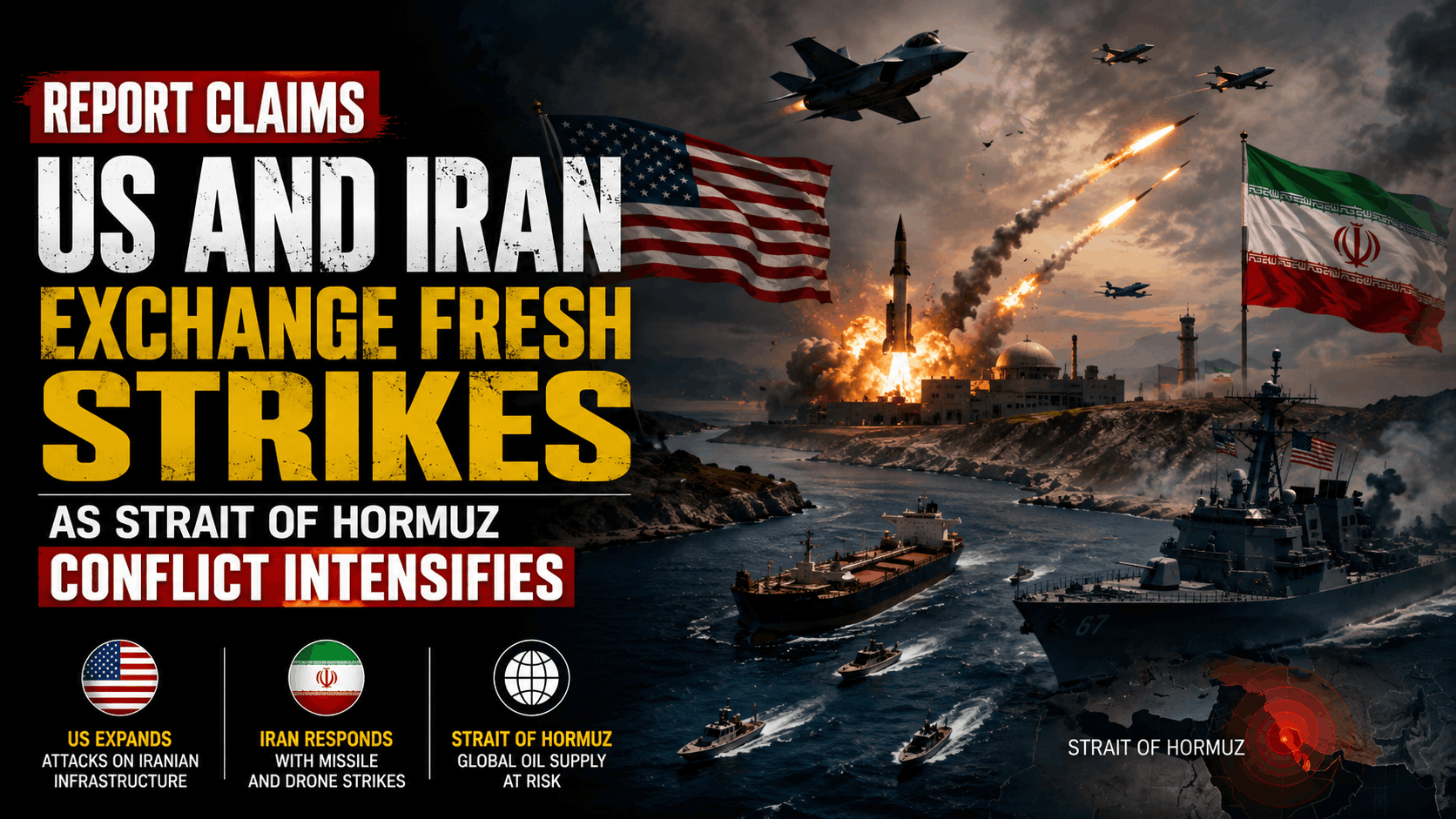
 New Delhi: According to the report, the United States and Iran exchanged fresh strikes across the Middle East on Friday, with both sides targeting infrastructure and military installations as tensions over the Strait of Hormuz continued to escalate.
The report claims the United States carried out attacks on bridges, energy infrastructure and a port facility in southern Iran, describing them as part of an ongoing military campaign aimed at weakening Tehran’s operational capabilities.
It further alleges that Iran retaliated by launching missiles towards several US-allied countries in the region, including Qatar and Kuwait, with one desalination plant reportedly sustaining damage.
According to the report, the latest attacks marked the seventh consecutive night of US military operations against Iran. Iranian officials reportedly said dozens of people had been killed and hundreds injured in the recent strikes, while US authorities acknowledged additional injuries among American service members.
The report also states that the Iranian military claimed two oil tankers caught fire while attempting to pass through a mined route in the Strait of Hormuz. However, it adds that the US Central Command (CENTCOM) denied the allegation, calling the claim false.
It further claims that Iran has effectively restricted shipping through the Strait of Hormuz since the conflict began, leading to disruptions in global energy markets and pushing international crude oil prices higher.
According to the report, US airstrikes targeted bridges in Hormozgan province, including infrastructure around Bandar Khamir, with the stated objective of disrupting transport links connected to Bandar Abbas, Iran’s principal port.
The report also says Iran acknowledged attacks on parts of its power infrastructure for the first time, with its Energy Ministry urging residents in southern provinces to reduce electricity consumption amid supply concerns.
Separately, the report claims that a tower at Chabahar Port collapsed following a US strike. Iranian authorities reportedly described the structure as part of the port’s commercial operations, while the US military alleged it formed part of a maritime surveillance network used by Iran’s Revolutionary Guard.
The claims in the report have not been independently verified, and the conflict continues to evolve amid growing international concern over regional stability and the security of global shipping routes.
