



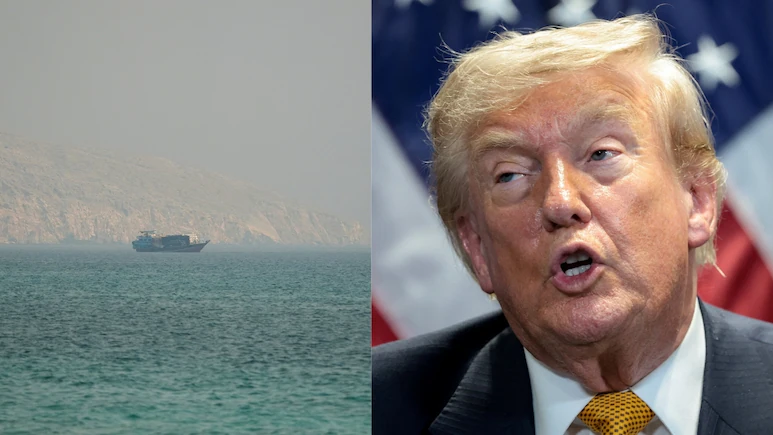
 New Delhi: Tensions in the Middle East escalated sharply after the United States launched a fresh round of military strikes against Iran following Tehran’s reported announcement that it was closing the strategic Strait of Hormuz, one of the world’s most important energy transit routes.
According to reports, Iran’s Revolutionary Guards declared the closure of the waterway after an incident involving a commercial vessel that allegedly failed to follow instructions issued by Iranian authorities. Tehran warned that the Strait would remain closed “until further notice” and cautioned against any foreign intervention in the region.
In response, the United States launched what officials described as a major military operation targeting Iranian military infrastructure. The strikes reportedly began on Saturday evening under orders from US President Donald Trump.
The US Central Command (CENTCOM) said the operation targeted approximately 140 sites, including missile and drone facilities, naval assets, ammunition depots, communication networks and coastal surveillance installations.
At 7:15 p.m. ET today, U.S. Central Command forces began launching the third round of strikes this week against Iran after Islamic Revolutionary Guard Corps forces blatantly attacked M/V GFS Galaxy, a Cyprus-flagged container ship transiting the Strait of Hormuz. A civilian crew…
— U.S. Central Command (@CENTCOM) July 11, 2026
According to CENTCOM, the strikes were intended to weaken Iran’s capability to threaten commercial shipping and civilian maritime traffic passing through the Strait of Hormuz.
Iranian state media reported explosions in several locations across the country’s southern coastline, including Bushehr, Asalouyeh, Bandar Abbas, Bandar-e Dayyer, and areas near the Strait of Hormuz.
Missile Alerts Across Gulf Region
Following the US operation, Iran reportedly launched missile and drone attacks targeting countries in the Gulf region, including Bahrain, Kuwait, Qatar, and the United Arab Emirates, all of which host American military facilities.
Authorities in the UAE said air defence systems were activated to intercept incoming threats, while Bahrain issued air raid alerts and advised residents to seek shelter. Missile warnings were also reported in Qatar, and Kuwaiti officials said defence forces were responding to incoming projectiles.
The developments have heightened concerns of a wider regional conflict involving multiple countries across the Gulf.
Strategic Importance of the Strait of Hormuz
The Strait of Hormuz remains one of the world’s most critical maritime chokepoints, handling a significant portion of global oil and natural gas exports. Any disruption to shipping through the route has the potential to impact global energy markets and international trade.
The latest escalation also threatens diplomatic efforts aimed at easing tensions between Washington and Tehran. Analysts warn that continued military exchanges and uncertainty over the future of the Strait of Hormuz could further destabilise the region and complicate prospects for a negotiated settlement.
The situation remains fluid, with governments across the region closely monitoring developments and assessing the potential security and economic consequences of the escalating confrontation.
