



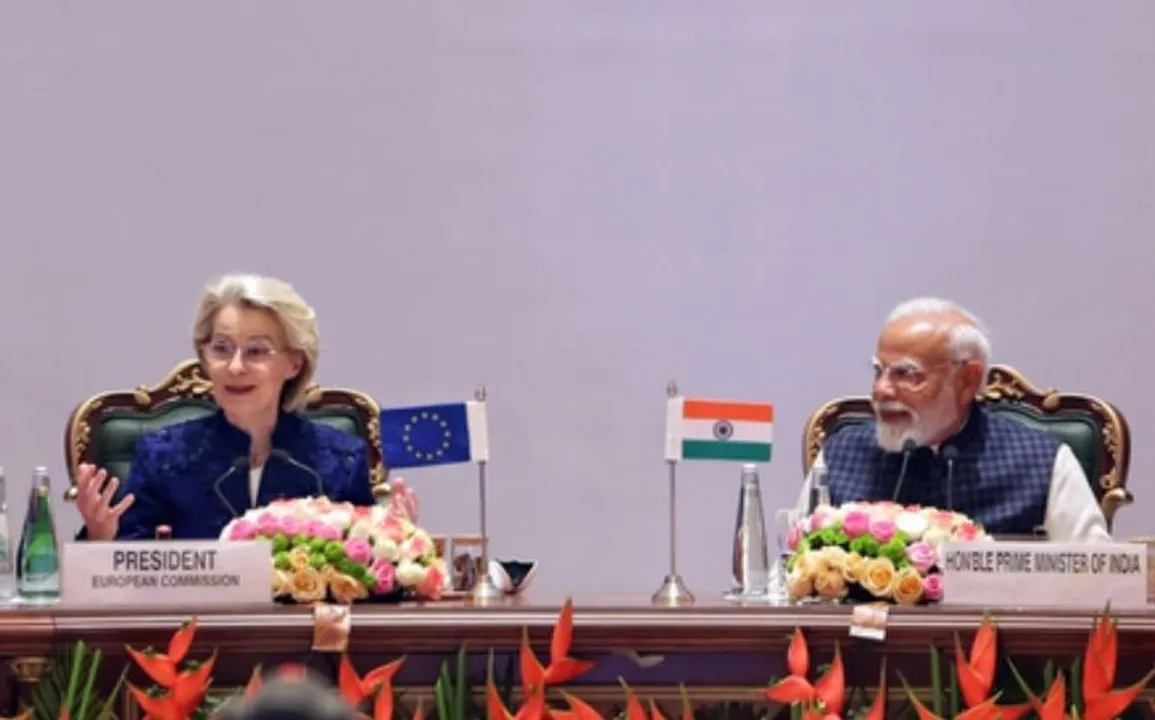
 Washington: The European Union has dismissed suggestions that recent shifts in United States trade policy under President Donald Trump were responsible for the conclusion of its landmark free trade agreement (FTA) with India, stressing that the deal is rooted in long-term strategic, economic and political interests shared by both partners.
Speaking during a discussion hosted by the Peterson Institute for International Economics, Christophe Kiener, the European Union’s chief negotiator for the agreement, rejected the notion that recent trade tensions accelerated the deal.
“We did not conclude this agreement because of a tweet,” Kiener said. “We concluded it because there is a genuine strategic and economic interest for the European Union and India to come closer.”
While acknowledging that the global trading environment has become increasingly uncertain in recent years, Kiener emphasized that the foundations of the agreement were laid long before current trade disputes emerged. He described the India-EU partnership as a broad and evolving relationship spanning trade, security, defence, technology and mobility, calling the free trade agreement “the jewel in the crown” of that cooperation.
Kiener noted that earlier negotiations were suspended in 2013 because the priorities of both sides did not align. However, when talks resumed in 2022, negotiations began afresh, paving the way for a more comprehensive agreement.
He said several global developments strengthened the case for deeper cooperation, including the stagnation of multilateral trade liberalisation under the World Trade Organization (WTO), disruptions exposed by the Covid-19 pandemic and the geopolitical instability caused by Russia’s war in Ukraine. These factors, he said, highlighted the importance of resilient supply chains and predictable trade partnerships.
India’s chief negotiator, Darpan Jain, also rejected claims that the agreement was primarily influenced by recent US trade policy changes. He pointed out that when European Commission leaders visited New Delhi in January 2025 and both sides committed to finalising the deal by the end of the year, the latest US trade policy measures had not yet taken shape.
“The new US administration had only recently assumed office at that time,” Jain said, adding that the commitment reflected the growing India-EU partnership and India’s broader strategy of expanding global market access through trade agreements.
Jain highlighted that India has concluded nine free trade agreements over the past five years and reiterated the government’s strong political commitment to strengthening international trade ties, improving opportunities for Indian exporters and enhancing economic engagement with global markets.
Both negotiators underlined that the significance of the agreement extends beyond economics. The discussion’s moderator, former European Trade Commissioner Cecilia Malmstrom, said the pact sends a powerful geopolitical message by demonstrating that two of the world’s largest economies remain committed to transparent, rules-based trade at a time when protectionist measures and tariffs are becoming increasingly common.
The India-EU Free Trade Agreement will now undergo legal scrutiny and ratification procedures before coming into force. European Union officials hope the agreement can be signed later this year and implemented in 2027, while Indian authorities have indicated that the domestic approval process will involve Cabinet clearance followed by presidential ratification.
