



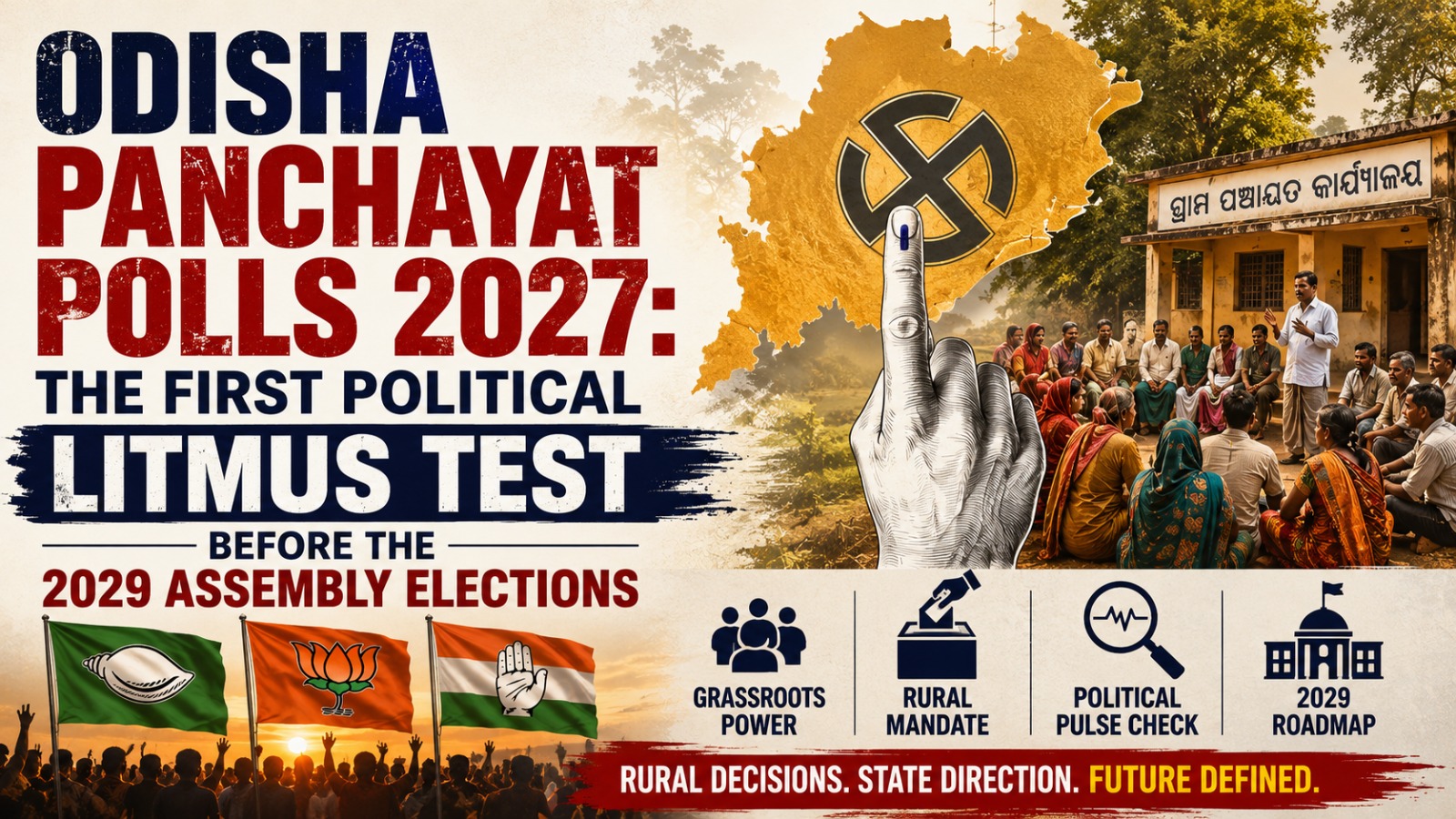
 Bhubaneswar: Though the Odisha Panchayat elections are still some time away, the state’s political parties have already shifted into election mode. For the ruling Bharatiya Janata Party (BJP), the opposition Biju Janata Dal (BJD), and the Congress, the 2027 rural polls will be far more than a contest for local self-government institutions—they will serve as the first major political indicator ahead of the crucial 2029 Assembly elections.
Political observers believe the Panchayat elections will provide the first statewide assessment of public sentiment following the BJP’s historic victory in the 2024 Assembly elections, which brought an end to the BJD’s uninterrupted 24-year rule in Odisha.
BJP Faces First Major Governance Test
For the BJP, the 2027 Panchayat elections will be an opportunity to prove that its 2024 triumph was not merely a result of anti-incumbency against the BJD but the beginning of a long-term political shift in Odisha.
The party has intensified efforts to strengthen its grassroots organisation, expand its booth-level network and induct influential leaders from rival parties. However, the BJP also faces significant challenges. Despite losing power, the BJD continues to maintain considerable influence across rural Odisha and retains a strong organisational structure built over two decades.
The state government has also faced criticism over issues including alleged errors in school textbooks, concerns regarding law and order, incidents of mob violence and several high-profile murder cases. These controversies have put pressure on Chief Minister Mohan Charan Majhi and Odisha BJP president Manmohan Samal to demonstrate both administrative effectiveness and organisational strength.
Political analyst Srirama Dash believes the elections could become a defining moment for the BJP leadership in Odisha.
“If the BJP succeeds in winning more Zilla Parishad seats than the BJD, it would validate the party’s growing grassroots acceptance and significantly strengthen the position of Mohan Charan Majhi and Manmohan Samal within the BJP’s national leadership,” he said.
The importance attached to the elections is evident from the attention given by the party’s central leadership. Senior BJP leaders, including national president Nitin Naveen and national general secretary Tarun Chugh, have already reviewed organisational preparedness in Odisha and assigned responsibilities to party leaders at various levels.
BJD Looks to Prove Its Grassroots Strength
For the BJD, the Panchayat elections may be even more significant. The party sees the contest as an opportunity to demonstrate that its electoral defeat in 2024 has not diminished its extensive grassroots support and organisational network.
Despite being out of power, the BJD continues to enjoy substantial influence in many rural areas. The active political involvement of Sujata Raut Karthikeyan Pandian has generated renewed discussions within the party and energised sections of the organisation.
At the same time, BJD president Naveen Patnaik has repeatedly stressed organisational discipline and unity as the party prepares for its first major electoral battle after losing power.
Political commentator Prasanna Mohanty believes the elections will effectively serve as a referendum on Naveen Patnaik’s enduring popularity.
“After governing Odisha for nearly 24 years, Naveen Patnaik now faces the challenge of proving that he remains the state’s most influential political leader even while sitting in the opposition,” Mohanty observed.
A strong performance by the BJD would reinforce the party’s claim that its support base remains intact despite the change in government.
Congress Seeks Political Revival
For the Congress, the Panchayat elections offer a realistic opportunity to rebuild its organisation and regain political relevance in Odisha.
The party’s Odisha in-charge Lalji Desai has initiated consultations with district leaders and launched organisational reviews across the state. Along with Odisha Pradesh Congress Committee president Bhakta Charan Das, he is focusing on strengthening the party’s structure and bringing younger workers into the fold.
Congress continues to retain pockets of influence in parts of southern Odisha and is also working to expand its presence in districts such as Kandhamal and Angul.
While the party may not be expected to emerge as the dominant force, a stronger performance could help it re-establish itself as a credible alternative and improve its prospects ahead of the 2029 Assembly elections.
Three Parties, Three Different Stakes
Political analysts note that the Panchayat elections carry different implications for Odisha’s three principal political parties.
- For the BJP, the contest is about validating public confidence in its government and proving that the political shift witnessed in 2024 is sustainable.
- For the BJD, it is about demonstrating that its grassroots machinery and voter loyalty remain intact despite losing power.
- For the Congress, it represents a chance to rebuild its organisation and re-enter the state’s political mainstream.
The Semi-Final Before 2029
Historically, rural electoral trends in Odisha have often influenced the outcome of subsequent Assembly elections. As a result, many observers already view the 2027 Panchayat elections as the political “semi-final” before the 2029 Assembly battle.
The results will shape political narratives, boost or weaken organisational morale, and influence electoral strategies across parties for the following two years.
A strong BJP performance would strengthen the leadership of Mohan Charan Majhi and Manmohan Samal. A BJD resurgence would reaffirm Naveen Patnaik’s stature as Odisha’s most formidable opposition leader and counter speculation about the party’s decline. For Congress, electoral gains would validate the organisational rebuilding efforts of Bhakta Charan Das and Lalji Desai.
Ultimately, the verdict of rural Odisha in 2027 will be about much more than local governance. It will serve as a crucial political litmus test that could shape the trajectory of the state’s politics and set the tone for the high-stakes 2029 Assembly elections.
